In the December, 1957 issue of The Canadian Forum, McLuhan penned a piece titled The Subliminal Projection Project, (available to read here) wherein he intended, with his usual haughty aloofness, to deflate the post-war paranoia around subliminal messaging in ads and propaganda.
 He belittles the popular fears about hidden messages in media by people who otherwise ignore the vast juggernauts of business and advertising who are “swiftly moving at present from an era when business was our culture into an era when culture will be our business.” That last line, adapted to present tense, later provides him the title of a book.
But in building his case, McLuhan makes some very surprising proclamations in reference to a very strange experiment.
In fact, the next stage beyond subliminal projection has already occurred in the providing of TV for the blind by direct wire to the brain centers, by-passing external physical perception altogether. This latter step is slightly more contemporary than the crudities of subliminal projection, and for those who enjoy the thrills of moral alarm here is a field indeed in which to cavort. Since there is nothing to prevent all of us being provided with cranial wall-plugs which would permit instruction in all subjects to occur endlessly during a physical sleep which could be indefinitely prolonged.
Obviously, I had to try and get to the truth of what McLuhan was referring to here. Yes, he’s predicting the simulation theory of The Matrix films, but that’s easily explainable by his deep stewing in Gnostic theory by this point in his studies. But what’s all this about “TV for the blind?” It clearly must be a gross exaggeration—nothing like this could have possible existed in the 1950s. Yet, at the same time, I’ve long-harbored a hunch that he must have premised this claim on some kernel of truth.
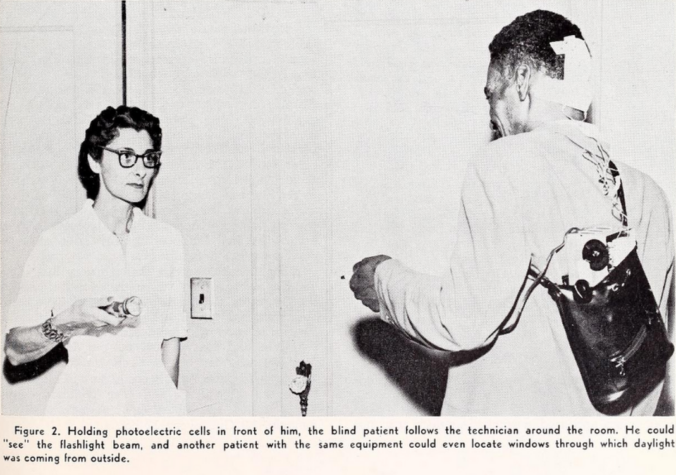
I did some digging, and hit pay-dirt. The most likely candidate for what McLuhan refers to as “TV for the blind” is recapitulated by the experimenters, Doctors John Button and Tracey Putnam, in a 1962 write-up they made for the January, 1962 issue of The Journal for the Iowa Medical Society (available to read here, emphasis mine):
Miss Betty C., age 36, had suffered a somewhat obscure illness at the age of 18 years. The diagnosis of a tuberculoma of the occipital region was made, and a decompressive operation was carried out over the left occipital bone, leaving a defect… The patient has lived the secluded life of a completely blind individual. She has learned to read Braille and to take care of her personal needs, but does not go out alone and has never sought employment.
When the possibility was explained to her that she might temporarily receive crude impressions of light as the result of a simple operation and electrical stimulation, she agreed to the experiment and proved most cooperative.
After some discussion we decided to utilize this opportunity in the simplest and safest possible manner, and to leave elaboration to the future. Accordingly, on October 29, 1957, the patient was brought to the operating room under light sedation, and the occipital area was shaved. She was then placed face downward on the operating table with a cerebellar headrest, and under local anesthesia four small burr-holes were made just lateral to the external occipital protuberance, on either side. Through each, an 18-gauge spinal needle was inserted to varying depths. Next, a 26-gauge stainless steel insulated wire with 1 mm. of the tip scraped bare was inserted through each needle, and the needle withdrawn over it. Thus, wires were left 1 cm. lateral to each side of the occipital protuberance at its upper rim, inserted to depths of 3 cm. and 5 cm., respectively, and a second set of wires 1 cm lateral to the protuberance at its lower rim were left inserted to depths of 1.5 cm. and 7 cm., respectively. Of these, the wires situated at depths of 3 and 5 cm. gave the most satisfactory results…
The wires were left in place, and a sterile dressing sealed with collodion was applied. Antibiotics were administered. Meanwhile, a crude light-controlled stimulator was assembled. This provided a somewhat distorted unidirectional square wave that could be transmitted to the buried electrodes through a cadmium sulfide photoelectric cell connected in series. In the dark, only a few microvolts were transmitted. In a bright light, the maximum current received by the patient measured 15-25 volts, 620 microamperes, at a rate of 120 pulses per second, with a pulse duration of .1 milliseconds.
When this device was attached to the buried wires, it was at once clear that the patient could tell whether the photocell was illuminated brightly, dimly or not at all. With a few moments’ practice, she learned to point the photocell at the light in the room. This she did repeatedly, pointing directly at a 40-watt bulb regardless of where, unknown to her, it had been moved. She described the sensation as a sort of diffuse illumination appearing across her entire visual field, somewhat as the sun might appear to a sighted person through closed eyelids. Following these tests, the electrodes were removed.
Obviously a single photo-receptor is a pretty far stretch from the rasterized oscilloscopy we first called television. Classic rhetorical embellishment on McLuhan’s part. But look at the timing! The experiment was performed October 29th, 1957. And McLuhan’s piece is written up, submitted, and published in time for December. I’m not sure what exact reporting of the experiment McLuhan may have read in early November of that year, but the timing strong suggests what happened. As soon as he heard it, he realized it was the perfect one-up to smack-down the popular media discourse of Freudian suggestion and secret messages and got to work.
It’s amazing to think that this bit of rhetorical flourish has become so prescient and literal over half a century later. But if anyone was going to hit a bullseye like this, you know it’d be Marshall!
Leave a Reply