
With agent-assisted console coding apps blowing up in the past half-year (Claude Code, Codex, Grok Build, OpenCode, etc.), 70s/80s-style text interfaces are making a comeback among surfers of the latest tech waves.
This throwback to the old textual interfaces of yore is extremely interesting. I explained how they work eight years ago when I started my McLuhan-inspired mission to explain the effects of the present media landscape. And looking at what AI coding is doing today, I believe that we can make a few predictions based on historical patterns.
Why this is happening
You can now just write modern computer programs and websites by talking to AI through an old-school computer terminal. Like, it’s literally a teletype interface, from the time before graphics and computer mouses.
That’s because the most powerful and useful coding programs are text-based terminal programs, and all computer code is plain text files. It’s also because the problem of remotely accessing computers was solved decades ago!
That’s what a “terminal” is; a dumb interface to connect to a remote machine on the other side of a phone line. When you see someone using a text terminal today in public on their laptop, odds are increasingly good that they aren’t even using their laptop except as a terminal. They’re actually using their home computer, or a more powerful cloud computer they’re paying to access.
Let’s forget about RDP/VNC because nobody likes them
You are already used to accessing remote computers through your own desktop, laptop, tablet, or phone. You usually do so via a web browser. Web browsers began as hyperlinked document readers. But with web-forums and MySpace and Hotmail, they slowly became the “window” into using remote computers. Now most people just use their computer to open a browser! They store all their stuff in “the cloud” and then waste hours of their lives every few months agonizing over having forgotten their passwords!
I frequently gripe against people who give all their data away to big corporations because it’s all they’ve ever been taught. The trick, though, is that these companies design their web-apps to be as easy to use as possible. You don’t need to think or learn anything, all the actual responsibility and control has been removed for your convenience.
Modern generative AI started out that way: most people who use AI do so (to their own detriment) through a “chat” box on a website. But now, with coding applications, people who have never touched a textual computer console before are learning how to use tools like Secure Shell and a terminal multiplexer in Bash or PowerShell to access remote computers just like professional developers do.
Notice the commonality: With both web apps (booo!) and with new AI coding apps (yay!), your computer is a channel to communicate with remote servers. And when you’re at work, like I am in the picture above, the natural way to use your coding agent is to run it at home and use your laptop or phone as a terminal to teletype.
But AI coding apps primarily create and manipulate files on your own machine! They feel like a co-user of your computer, a friend on the inside. Of course, they do rely on remote AI data centres, which are receiving copies of the files they touch. And they’re all set up to push those files remotely to Microsoft’s GitHub (always beware the “integrations” buzzword). But if you have thousands of dollars to spare (I wish!) you can run them locally! And just a bit of work lets you easily change your git server to a freedom-respecting platform like Codeberg, like I did!
So what’s been skipped over?
So in 2026, tons of users are suddenly leaping from everything being in a web browser to everything being back in a text terminal, like it’s the 1980s.
Between the web browser and the terminal lives, frozen in amber, the entire object-oriented paradigm of your graphical operating system. Remember Windows? Or MacOS? The thing you run to get to the web browser? The thing that runs the fake-ass phone software that doesn’t look like any other application on your PC?
When the GUI was being popularized and taught, the notion of objects in cyberspace that you could click with your mouse became the dominant metaphor to hide the scary text-terminal interface. Programs would be written in standardized Object Oriented interface styles that users could remember and apply everywhere. This is what made them user-friendly while still being extremely powerful—today’s software for finger-painters is a malicious joke by comparison. I presented at LibrePlanet 2022 on this subject (but the audio wasn’t very good so at least check out my slides at the bottom)!
But owning a computer, soon, wasn’t enough. The buzz around the internet, the world-wide-web, and global connectivity totally eclipsed the vast potential of mere offline computing. The mania for interconnecting everything, I’ve said over and over, was a catastrophe for private property rights, privacy, and cognitive security. It was a great boon for the information economy.
Now, we see, Sony wants to games sold on discs, and deletes movies users have paid for. All the stuff people think have “bought” can be deleted and sold back to them according to EULAs users didn’t read. Boo hoo.
Pardon me, but it’s hard to take seriously complaints about companies deleting digital media after growing during the incessant, uncritical celebration of those all that digital media two decades ago.
The public should have always known virtual media meant the loss of private ownership. Every consumer watchdog and civil liberties group should have been clanging the alarm bells then. But the power of advertising dollars and bought-off colleges and universities and people’s unwillingness to learn anything hard lead to the normalization of Netflix and Spotify and various online software “stores” without discs and paper manuals and liner notes.
We can return!
If you’re old enough, then you used to buy computer software at the store. And you’d put the disc into your computer and install it and run it there. No internet necessary.
With AI Agent coding, we stand at the threshold of bringing that back. Local software, that runs locally on your machine. This is a dream I’ve had for a long time. Computer hardware, after all, will run whatever software you put on it. All the software you have that doesn’t actually need an internet connection shouldn’t have one!
But here’s my punk hacker ethos coming into core-conflict with the business models within-which all your retirement money is invested. Companies need to spy on you and control your software so they can keep profiting with the endless bullshit our stupid consumer markets let them get away with. Deleting stuff you liked and selling it to you again in a new skin. Watching everything you do and profiling you.
Politicians aren’t going to fix this shit for you—they can only, as has been demonstrated over and over, make it worse. Regulators will not save you. It’s your computer. Only you can save you—if you become far more discriminating.
You know how your phone asks your permission to let an app access your camera or microphone or contacts? Well, there’s a reason the GrapheneOS developers had to manually add a “Network Access” permission to their custom fork of Android: Google doesn’t want you let you, by default, deny an app its internet access. That would actually be a catastrophic choice. It would make users actually question, when asked, “wait, why does this app even need to go online?” Better to never ask: every app on your Android phone is online, all the time.
A moment of disillusionment
Back in 2022, the KDE Community was setting new project goals and soliciting vision statements. I wrote a long proposal titled Unplugged: Optimize KDE for Long-Term Offline Computing.
If you don’t know, KDE began in the ’90s as the Kool Desktop Environment; they create one of the major graphical user interfaces for GNU/Linux-derived operating systems. It’s so big that Valve, the video game giant, made it the default GUI for their Steam Deck. And as a long-time loyal user, I was promoting their new releases on Slashdot, as HatofPig, back in 2005! (My /. username comes from a Something Awful Shmorky cartoon, by the way…)
So here’s what I proposed to them: let’s start targeting people who want to unplug. I say that Freedom really means owning your own stuff. And KDE should pivot to giving users a ton of useful tools that make an independent, unconnected computer completely useful. Just like computers used to be. Offline dictionaries by default, pre-installed, so people stop looking up definitions in a search engine. Handy reference encyclopedias. Better help documentation. Figure out all the most popular stuff people do on browsers that could be done locally, and then make local-only, offline versions.
Well, here was the first reply, from user lordhelpus:
Don’t bother; even if what you’re suggesting is adopted, it won’t last long. Mandatory backdoors are coming soon (in EU too). What gives you the impression that they will even let computers to remain offline once these laws are passed, given the swift expansion of satellite and mobile coverage?
KDE devs have essentially confirmed that they share my belief that we are all doomed when I urged them to speak up, despite their refusal to admit it to themselves.
We must all acknowledge what we already know in our hearts: we are not people. We are only the cattle of the rich and powerful. And we’re reaching the point where humans are no longer useful; at that point, we’ll either be replaced by machines or forced to sacrifice even our right to the privacy of our thoughts by getting cyborg implants, which will undoubtedly be even less free than today’s smartphones. Human freedom’s brief golden age is coming to an end…
These are all things on the fore-front of my mind! Everything I do here, and on LessMad, is an effort to indicate truly constructively means of addressing these very issues! The entire ethos of Free Software was began with the effort to actually, by technological and legal means, secure Freedom for individual users. My proposal was exactly that: a practical roadmap for creating a Freer future for users.
Very quickly, however, a prominent lead developer stepped in to set the tone:
“lordhelpus” is a troll who posts doom porn everywhere, and can be safely ignored. I delete his negative and demotivating comments on my blog on a regular basis.
@lordhelpus if you derail this comment thread with your nonsense, I’ll ask sysadmins to ban your account and IP address and delete your comments (and this one). I’m a little surprised it hasn’t already happened.
And that was probably the moment when any interest I had in seriously participating in KDE software community was extinguished.
Open Source Software contributors do not, in any coherent way, really care about the Free part. They care about children’s cartoon virtues about sharing your toys and making friends. I’m not knocking those virtues; I’m just saying that they hardly comprise a complete ethos for living in our technological landscape. They’re just cherry-picked to reduce fighting in the classroom or “community”.
And you know what I think about communities!
If you want something done right…
Well now, thanks to AI coding agents, I can just build the desktop computer applications that I’ve always wanted!
Finally I can be the main designer and software engineer, developing the plans and architecture and vision statement. It’s the most addictive activity I’ve ever dove into.
Here’s, for example, is just one program I’ve made. It’s called Corbomite and it’s a Markdown note taking app which you might find suspiciously familiar:
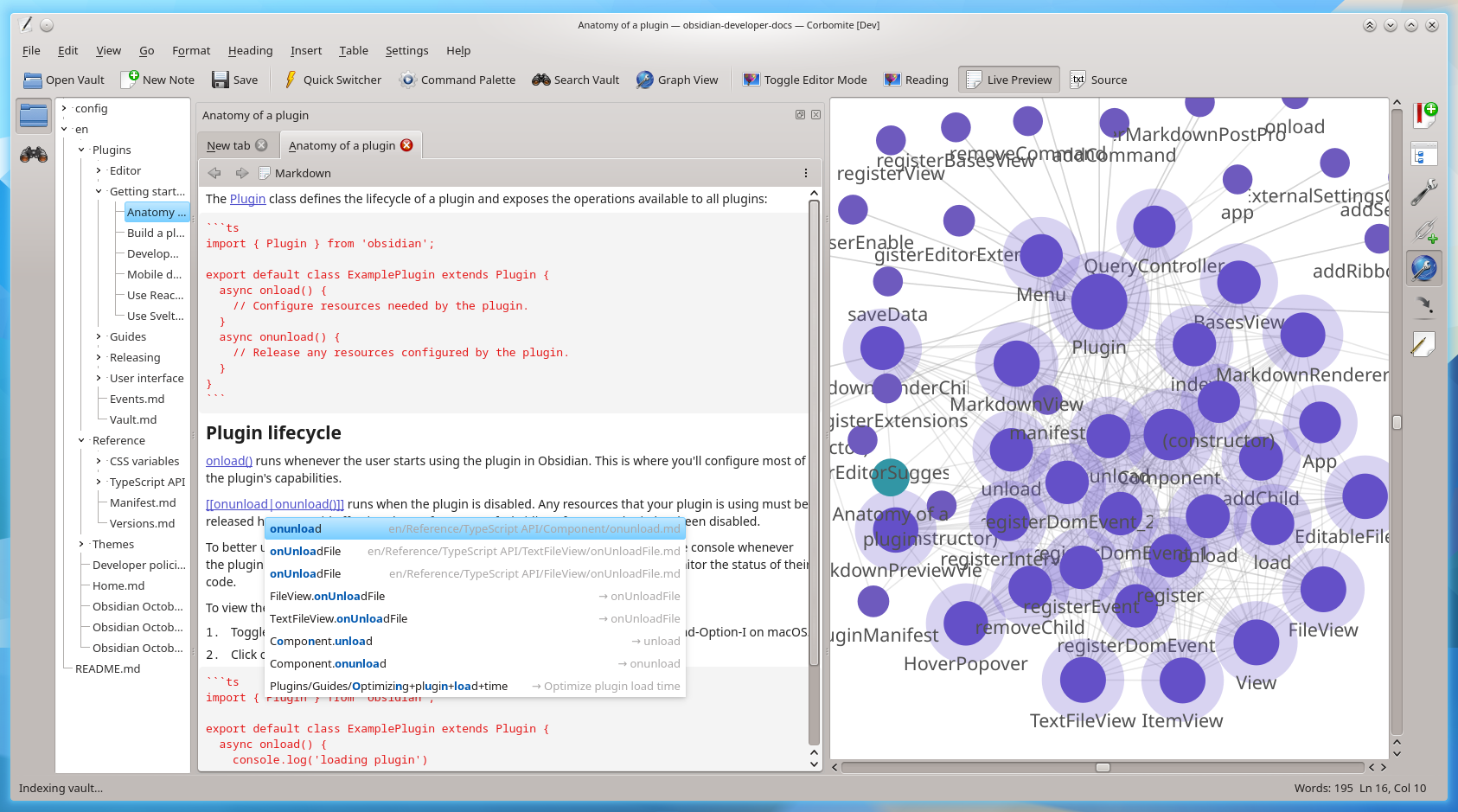
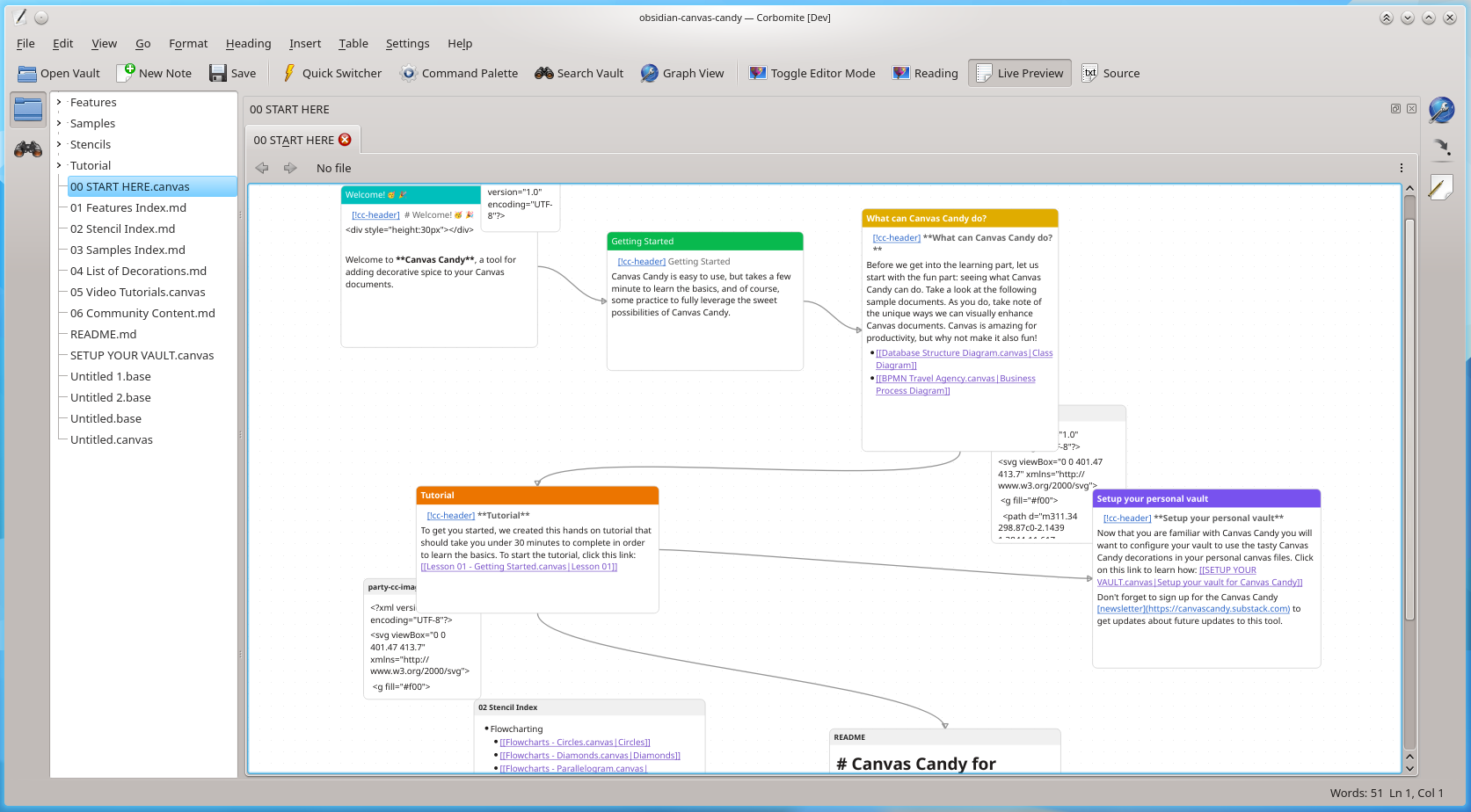
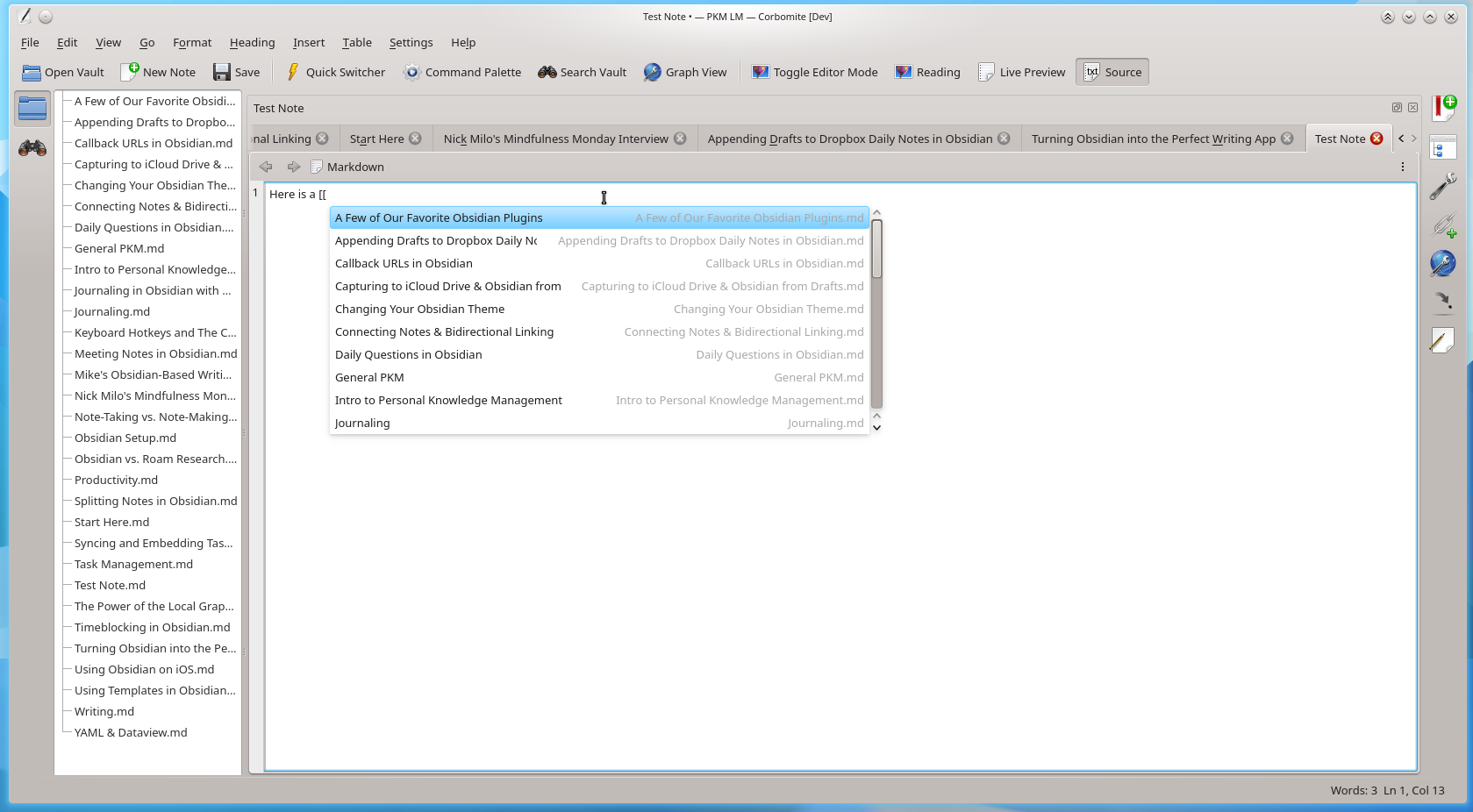
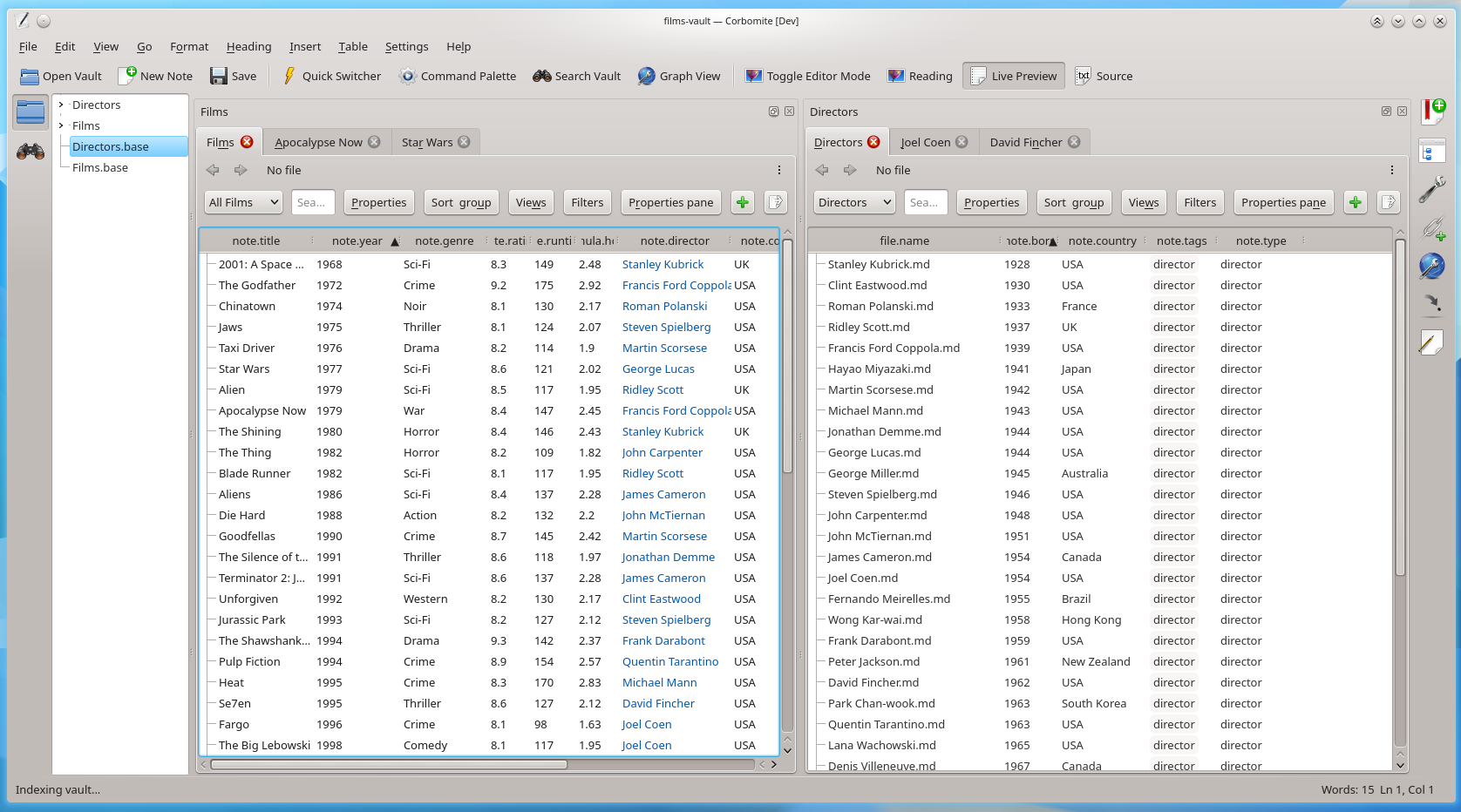
I have worked on it for months. The entire stack of reusable libraries I had to create to power it are the most maddening parts! The custom CDRT (that should surprise you), the collaborative markdown library (what?), it’s Qt widgets (both QML and QWidget), the generic graph renderer (now publicly available, as of today)… all have consumed entire days of my life, to the neglect of a great deal more important things.
I haven’t released Corbomite’s source code yet, or many of its libraries, because it’s not quite usable and I’m a perfectionist. In fact, I’ve got a bunch of software made the world has never seen, all in states which are forever almost good enough. That is, until I have an epiphany and decide to decompose and refactor the whole thing into an ever higher states of complexity. That’s my current doom loop. My vision keeps kicking the can down the road, and AI agents let me manipulate entire code-bases like a plasticine ship of Theseus.
I’m quite nervous about sharing my many advanced desktop apps because I hate sharing incomplete work. But, also, I’m starting to worry about my own ability to finish it all myself on a reasonable timeline. And reader, please understand: I work at The Beer Store. I cannot sustain this level of compute any longer.
I also know, however, that inviting contributors to a Free Software project invites a massive amount of work. Now I have to vet everyone else’s code too? Not just my own? I have to spend hours communicating about the work instead of just doing it? Managing other people? Argh!
What the future holds
I predict a huge swing toward offline computing among anybody who cares about their civil rights and freedoms who has even the slightest technological discernment. Most of what’s being sold today is garbage. Because Freedom can’t be bought or sold with money; personal emancipation is totally orthogonal to the market upon which eCommerce and the digital economy is presently built. Our whole society works to exclude and discredit anyone who achieves it. But if you want it, it’s always there for the taking.
We needed to remotely access machines with terminals back when the computer you could buy was too week to do what you wanted. With AI, that’s exactly where we are at today. All these big datacenters are doing things my home computer can’t. But keep a calendar? Proof read my grammar? Send pictures or life updates to my family? Organize my notes? Make slideshows? Collaboratively edit a document? We absolutely do not need any big server in between our personal computers to do any of those things for any technical reasons.
With AI, we are once again seeing a recapitulation of McLuhan’s (actually, Mallarmé’s) maxim about consumers being producers under electric conditions. We can just make the software we use better and more free. That’s what I’m doing. But, after these many months, I think I need to open up a bit. Maybe, even, ask for help from like-minded people.
Everyone says they want privacy. And they also want software that is easy to use. The ’90s-style GUI and design guide, with a mouse-and-keyboard interface, was always the sweet spot. Everything since them has been dumbed down in order to enslave you. So let’s just retrieve that! That’s been my work the past few years!
The best part is that AI is allowing people to use powerful old tools, such that the new software we make will be easy by comparison. We can socially re-engineer proper full-stack media ecology from the bottom up!
I’m putting this out there to know if anyone is interested this work and, more specifically, to ask how so. Does the idea of making your own real computer desktop software—software that does everything existing, annoying, ever-changing web-software does—excite you? Does being disruptive in the name of freedom entice you? Do you want to see the other super-secret projects I’m working on?
Follow me @clintonthegeek or hit me up at clinton at this website’s domain. I’m open to ideas! 🙂
Leave a Reply