Concerned Netizen

Full-Stack Media Ecology

Page 5 of 10

The Best Book Never Written on Amiga Computers

I’ve been thinking a lot about how much Apple and Microsoft have sucked up all the air in the room regarding the history of microcomputers. Docudramas, biographies, and news stories exalt the dominance of the two major corporations creating our PC environments.

What culture needs is the larger picture, the fuller story of the way these machines entered into our world. I remembered a series of articles I had read over a decade ago regarding the history of Amiga Computers. Just like the mythos around Woz and Jobs in the garage, wiring up the first Apple machines, the story of the Amiga is charged with wonder and marvels.

I rediscovered those articles today, and discovered that the series has tripled in length since I first read them. Since they’re spread throughout the site, I’ve compiled the “chapters”, as it were, …

Ambient Music Arrives Too Late

I’m listening to Klaus Schulze and he’s really good at creepy ambient stuff.

I feel like, had technology been around to allow the production of this sort of music, it would have been perfectly on-time 50 years earlier. That’s a mismatch between the artistic aspiration and the faculties of the time to meet the requirements. Maybe painting and stage-play was then at where this music arrives later.

We have to consider the time-fractured sensorium, owing technological disparities, as a player in the defeat over the holistic human individual and their own coherent emotional expression. This is the trauma of the bomb, and the post-war ear.

Jackhammers and machines created Jazz with all its discontinuities out of environmental impetus. Le Corbusier called the staggered skyline of Manhattan “hot jazz in stone.” But perhaps ambient music was something ideal to counteract all …

McLuhan and Art as Occult Gnostic Initiation

VoegelinView, the website for the Eric Voegelin Society, is running a 4-part special series on the correspondences of Marshall McLuhan and the German-American political philosopher. The series is written by Cameron McEwen of the McLuhan’s New Sciences blog.

Voegelin’s The New Science of Politics (1952) posits a continuity of form between the ancient Gnostic beliefs and contemporary political movements. A year after the release of The Mechanical Bride (1951), McLuhan had, shall we say, a “breakthrough” into the nature of the poetic techniques he had been studying from Romantic poetry, through Symbolism, into the Modern styles as a process of psychology. A useful adumbration of his scholarly “perspective” on this development can be found in Through The Vanishing Point (1968), by McLuhan and Harley Parker:

Concern with the processes in the arts led some nineteenth-century aestheticians to consider that

Media Shamanhood

I was asked by the Maniphesto Media Academy to give a talk on Marshall McLuhan, and decided to take the opportunity to be as radical as possible in re-writing the book!

I want to re-record this with a pre-written script, so as to avoid all the umming and stuttering, so please provide as much feedback, corrections, and opinions as you can to help me make this a solid introduction to Media Ecology!…

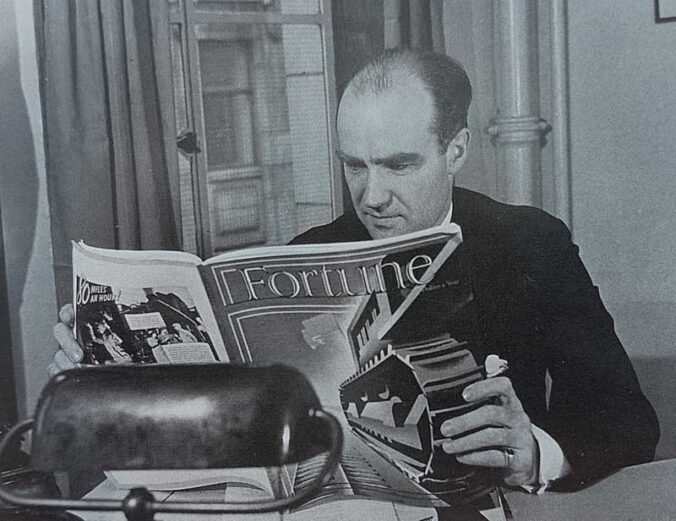
TIME, LIFE and FORTUNE

or
The Psychopathology of ‘Time’ and ‘Life’
or
The Ballet Luce
by Marshall McLuhan, 1947

It would seem a very good time to take stock of the performance of this trio now that Mr. Luce has begun to think seriously of adding a fourth star to his stable. The fourth member is to be definitely high-brow, if it appears. And in passing from glorified spot-news (Time) to nursery entertainment (Life) to managerial grand opera (Fortune) to high-brow criticism, Mr. Luce must still have an eye on Der Verlag Ullstein from whose activities and methods his own are so largely derivative. Thus Ullstein Querschnitt printed Pirandello, Proust, Cocteau, Woolf, Mann, and others in their original languages, and aimed to be “a monthly for the literary gourmet” and for “the intellectually indulgent, the well read, the …

Product Designers are the new Ad Men

Affordances are, for cognitive scientist John Vervaeke, the primary features of our perceptual salience landscape. The overlap between the salient landscape and McLuhan’s inner landscape are striking. Whatever is salient to us in our environment comes to our attention by proposing some interaction or participation with it (i.e. involvement for McLuhan). For the English professor McLuhan, steeped in art criticism, it is the deviation between the interior landscape and the material environment which he found of particular salience—particularly as it this gap presented itself as an abysmal,  in-salient void to nearly everyone else.

After James Gibson coined the term affordance (he also coined the term percept in the ’50s, a term used by McLuhan in counterpoint to concept) the handle was taken up by product designers and HCI (human computer interaction) theorists as a means of creating easy-to-use …

God’s Man on the Inside

Over the past six years I’ve typed out some 4000 personal notes of many various sorts. There have been weeks where I’ve typed some 5-10 thousand words a day, and some weeks where I haven’t written a thing. Many are commentaries on books, films, and online discussions with excerpts, page references, and time-codes. Many are snippets of stray thoughts and ideas, or delicate words which had floated into mind which I had fancied enough to preserve. A great many are long dumps of stream of conscious thoughts, begun with the intention to write-down a conscious thought-in-mind, but which sprawled outward during the recording into unforeseeable tangents and strange destinations.

Ideally I’d take some of these long essays and polish them, or dissect them, into proper essays or papers. But in reality, I’ve seldom the time nor inclination to revisit my

Teletypes: The transition from computer typography to screen

Most of the apparent “revolutions” in computing over the past decades have been a matter of surface representation, or appearance. That is to say, the underlying nature of the machines, or hardware, have improved incrementally in a rather boring, linear way. This stable, predictable ground, however, has long been out of cultural reach.

The top-level, apparent layer of representation—and the applications these human computer interfaces afford—are most responsible for whipping up the maelstrom of runaway technological progress. It could be said that Apple Computers’ entire business model is based on selling the newest skins for their old cider!

In McLuhan’s use of the term, “software” means not just 1s and 0s specifically, but all formal aesthetics or content.

Every new conquest of speed moves toward the minimizing of “hardware” and the maximizing of “software” or structural design.

As the West approached this awareness in the nineteenth century, biologists began to ask, “Why is there so much unused beauty in Nature?” The answer came later, from the mathematicians in the world of “software.” “If an equation is symmetrically beautiful, it is almost certain to be true.” What the artist has always known, namely, that the greatest effects result from the utmost economy of means, has now become a truism of the material sciences.

the unexpected effect of “hardware” speed-up has been to restore the world as a work of art or object of contemplation.

As a work of art, the world impels the viewer to Make it New, to cite the Chinese injunction to the artist concerning his role. Man becomes both explorer and maker of beauty as “hardware” and “software” merge. The “hardware-software” complementarity is a new version of the old form-and-content relation. The old hang-up about “form” and “content” had arisen under the regime of merely visual culture, where “content” had to be contained in something. With the figure-ground relation of Gestalt psychology, the “content” was continuously created in the gap between figure and ground. The new physics carried this relation even further, citing resonance as the very stuff of “hardware.”

Marshall McLuhan and Barrington Nevitt, Take Today: The Executive as Dropout (1970), pg.95

Even hardware forms, like computers themselves, are software when designed on a computer. This is why Friedrich Kittler said in his essay There is No Software that the last historical act of human writing was in 1971 with the planning diagram for Intel’s 4004 microprocessor—the first single-chip CPU.

And so understanding the plastic history of computer I/O (input-output) interfaces is essential to appreciating the breadth of effects computer content has had. The contemporary cultural image of “hackers” pounding away on keyboards in dark black boxes of monospaced text make a lot more sense when the typographical origins of computer interfaces are understood.
No computer history lesson is complete without the story of the telegraph, and its intimate relation with contemporary computing at every level, low and high. This excellent article from How To Geek covers, at least, the high ground:

https://www.howtogeek.com/727213/what-are-teletypes-and-why-were-they-used-with-computers/
Stitched Into the Matrix: A Review

Since the industry’s pivot to peacetime in the late 1940s, computers have come to constitute our modern material environment literally, metaphorically, and aesthetically. Like a store-front window marketing display by Frank L. Baum, the ground-floor, street-facing show-room of IBM in the 1950s offered New Yorkers (regardless of outdoor conditions) a brightly-lit, unchanging view into the timeless, abstract world of computing outside of our own (Harwood, 46). Engineers in white lab coats moved spindles of tape and decks of cards, literally working inside the computer as they bused data between shiny large cabinets for curious onlookers twenty-four hours a day.

And there went everybody. The nature of the data being processed—demographic, financial, the results of opinion polling and sales data and audience testing and tracking—placed newly-minted “consumers” even deeper inside of computers. Not as components within the computer’s functioning, but as

Two new long video interviews

In the past two weeks I’ve been interviewed twice on two different excellent podcasts.

The first was for the first McLuhan Symposium on the Parallax Podcast Sweeny vs Bard hosted by Alexander Bard and Andrew Sweeny.

And the second was with James Kourtides on his podcast The Rooster’s Crow.

Check them both out!…

« Older posts Newer posts »

© 2026 Concerned Netizen

Theme by Anders NorenUp ↑